FREE sourcing support with eligible support valued at up to 3%. Eligibility applies to qualified business buyers and is confirmed after we review your product, quantity, destination, and sourcing requirements.

Buyer requirement guide

Build a Custom Golf Cart Procurement Brief

A useful RFQ is not a wish list of accessories. It connects operating duty to a defined seating or cargo layout, performance assumptions, quantity, destination, evidence needs and a comparison basis that factories can answer.
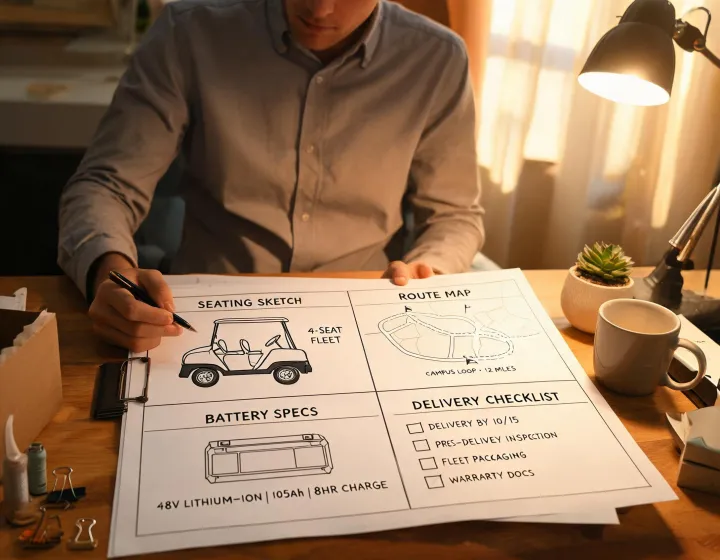
Custom golf cart procurement brief workshop
DutyWho or what moves, where, how often and under which conditions
VehicleBody, seats, load, speed class, battery and accessories
OrderQuantity, destination, timing, documents and quote basis

Resolve Open Choices Before Supplier Outreach

Passenger layout or utility body?

Count occupants, accessibility needs, luggage and cargo separately. A rear flip seat, fixed passenger seat and cargo deck change use, load distribution and quote scope.

Record in the brief

Seat count and orientation, entry or accessibility needs, roof and enclosure, cargo dimensions, payload basis, hitch use and reference images or drawings.

Standard cart or low-speed vehicle?

Do not choose by top-speed language alone. Intended road or site use may change equipment, category, documents, registration and destination review.

Record in the brief

Operating roads or controlled property, desired speed class, lighting and safety-equipment questions, jurisdiction, model year and exact-model evidence requested.

Battery size or duty-cycle fit?

A larger nominal kWh figure is not automatically a better operational match. Usable capacity, load, speed, grade, temperature and charge window shape actual duty coverage.

Record in the brief

Daily distance, shifts, stops, grade, surface, load, ambient range, usable battery capacity, charger, connector, available power and expected charging window.

Five Review Gates for a Buyer Brief

1. Is the configuration unambiguous?

List body, seating, cargo equipment, weather protection, powertrain, battery, charger and accessories. Mark acceptable alternatives as alternatives, not silent substitutions.

2. Are ratings tied to the offered cart?

Ask whether occupant, payload and towing statements apply after the quoted body, battery, accessories and load assumptions are included.

3. Is range explained?

Request nominal and usable capacity, range method or assumptions, speed, test load and environmental basis. Your own route evaluation remains necessary.

4. Is the price scope itemized?

Keep vehicle, customization, charger, tooling, inspection, documents, inland transport, freight and destination exclusions separate under one Incoterm.

5. Can the offered evidence be traced?

Match specification and regulatory references to the exact vehicle category, model, configuration and model year; do not treat a company-level document as vehicle approval.

Also state MOQ flexibility, sample or pilot-unit expectations, requested production and shipping window, inspection stage and packing method. None of these are confirmed until the selected supplier accepts the exact scope.

Send a Brief That Factories Can Quote Consistently

Add your optional budget with currency and per-unit or total-order basis, plus a high-end, mid-range, budget or undecided supplier preference.

Prepare My RFQ